


Snapshot
What happened
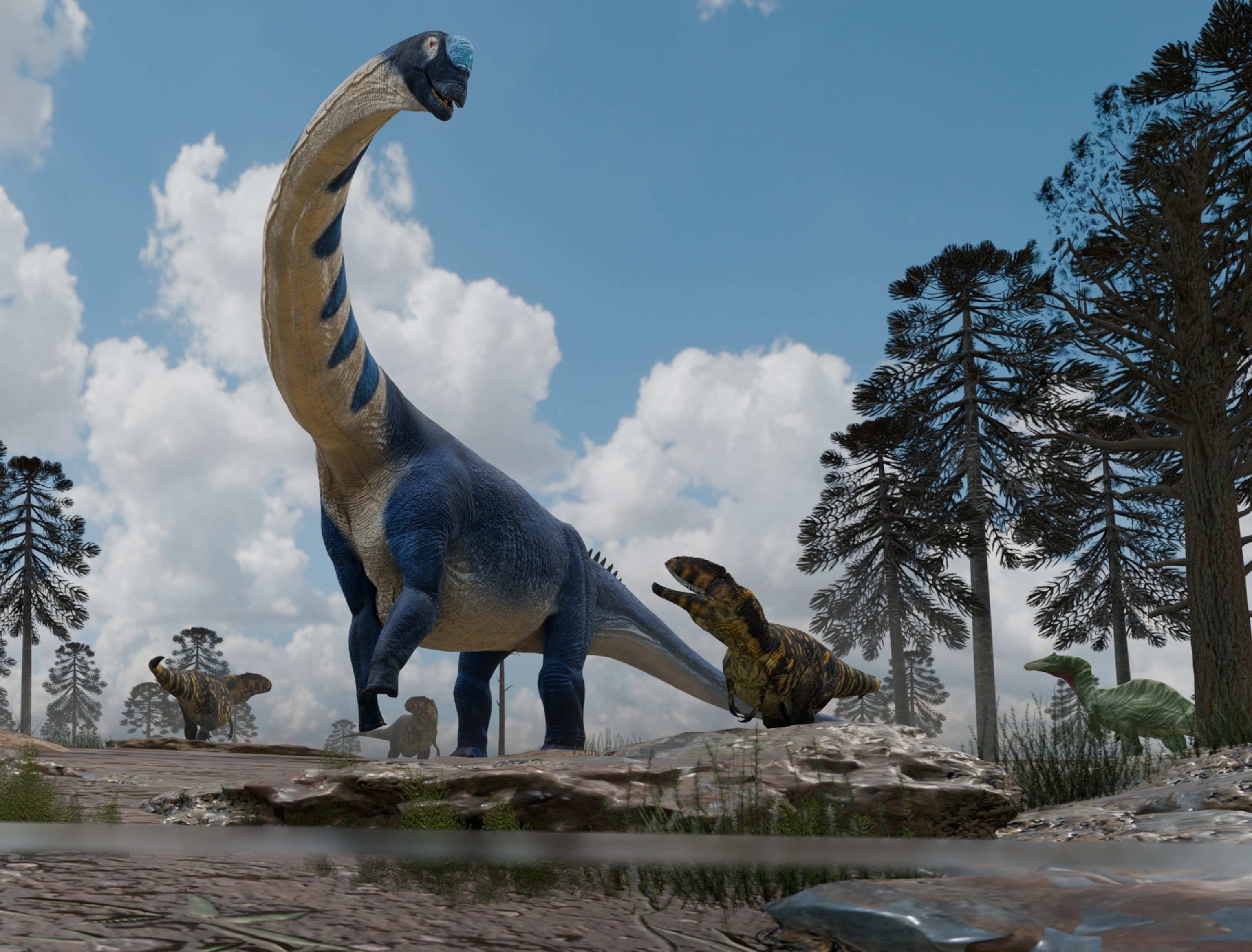
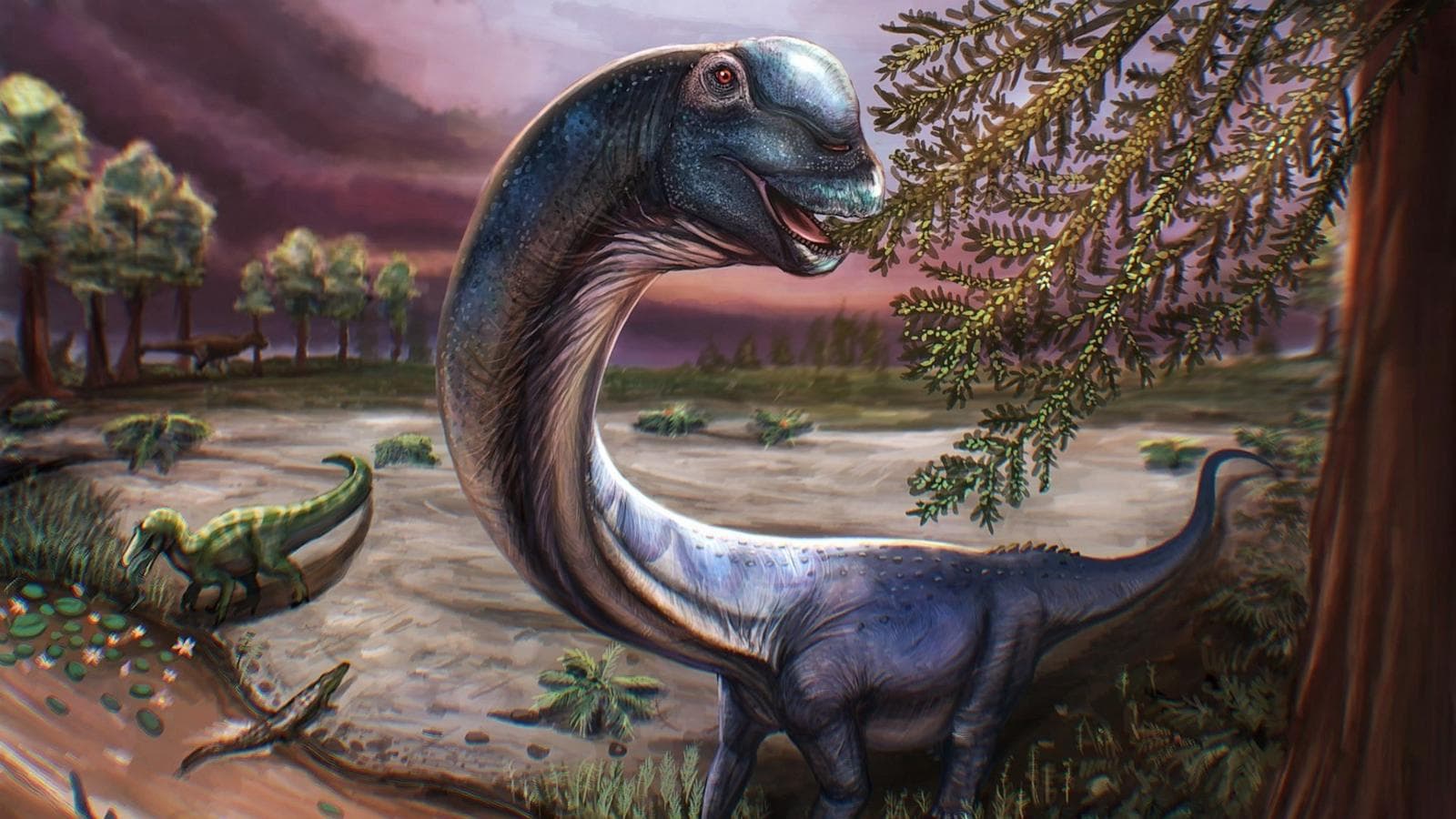
- Researchers have identified Nagatitan chaiyaphumensis, a new gigantic long-necked, herbivorous dinosaur species, in northeastern Thailand, establishing it as the largest known dinosaur discovered in Southeast Asia.
- This sauropod is estimated to have been approximately 88.5 to 90 feet long and weighed between 27 to 30 tons, with its front leg bone alone measuring nearly six feet.
- Nagatitan lived during the late Early Cretaceous period, roughly 100 to 120 million years ago, with its remains entombed in 113-million-year-old rock formations.
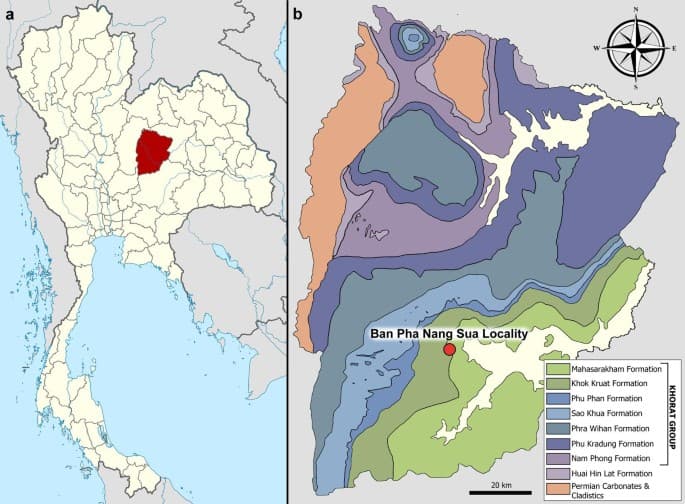
- The fossils were initially discovered by local residents in Thailand's Chaiyaphum province in 2016, leading to an excavation that was later halted around 2020 due to funding issues before resuming in 2023 or 2024.
Why it matters
Competing interpretations
Some interpretations highlight Nagatitan as a crucial piece of the global paleontological puzzle, offering insights into sauropod evolution and ancient ecosystems. Others frame it primarily as a symbol of Thai national heritage and scientific achievement, emphasizing its "largest in Southeast Asia" status and the local discovery. A third lens views it as an opportunity for public engagement and education, aiming to inspire a new generation of Thai paleontologists and foster broader appreciation for science.
Where disagreement lives
The core facts of the discovery are largely undisputed. Any subtle "disagreement" lives in the emphasis placed on different aspects of the story: whether the primary significance is purely scientific (evolutionary trends, environmental context), nationalistic (largest in Southeast Asia, "last titan" of Thailand), or socio-economic (reigniting interest in paleontology, potential for tourism). These are not conflicting claims but rather competing interpretations of the discovery's most salient feature.
What's still uncertain
The full skeleton of Nagatitan has not been recovered, meaning some size estimations are extrapolations from partial remains. Specific details regarding the initial local discovery in 2016 and the exact timeline and nature of the funding lapse between 2020 and 2023/2024 are not fully elaborated across all sources. The precise long-term economic or tourism impact on the Chaiyaphum province or Thailand generally remains speculative.
Who Is Affected
Thai Paleontological Researchers & Students
Increased funding opportunities, enhanced prestige, renewed public interest in their field, potential for career growth and international collaboration.
Local Communities in Chaiyaphum Province
Potential for increased tourism, local employment opportunities (e.g., guides, museum staff), and a sense of local pride, but also potential for disruption during excavations.
Thai Government & Cultural Institutions
Opportunity to promote national heritage, attract scientific investment, and boost cultural tourism, enhancing Thailand's global image.
Human stakes
The discovery of Nagatitan chaiyaphumensis resonates deeply with ordinary people by connecting them to the awe-inspiring scale of Earth's ancient past. It sparks local pride in Chaiyaphum, offering a unique identity and potential for educational engagement for children and families. The narrative of the "last titan" evokes a sense of both wonder and responsibility, highlighting the finite nature of such discoveries and the importance of supporting scientific endeavors that expand our collective understanding of life's history. It quietly underscores the value of sustained, often underfunded, scientific work that ultimately enriches our shared human story and cultural heritage.
Source spectrum
Issue intelligence
Judgments for navigating this story—not scores. Expand tooltips on each chip for rationale.
Note. Evidence confidence is about factual solidity; uncertainty is about how open-ended outcomes still are. Both can be high at once.
Decision matrix
Compares major options at a glance. Cells are summaries, not forecasts; tradeoffs are simplified for clarity.
| Option | Upside | Risk | Who benefits | Who bears cost |
|---|---|---|---|---|
| Prioritize sustained government funding for paleontological research. | Ensures continuity of scientific work, builds national expertise, contributes to global knowledge. | Competing budget priorities, potential for political interference in research direction. | Scientific community, future generations, national prestige. | Taxpayers (indirectly), other government programs. |
| Focus on private sector partnerships and international grants. | Diversifies funding sources, potentially brings in more resources and expertise. | Research priorities might be influenced by funders' interests, less public accountability. | Researchers, specific funding organizations. | Public (if research becomes less accessible or less aligned with national interest). |
| Emphasize public outreach, museum exhibits, and educational programs. | Increases public engagement, inspires youth, potentially generates tourism revenue. | Can divert resources from core research, risk of over-commercialization or simplification of science. | General public, tourism sector, educational institutions. | Research budgets (if resources are reallocated), scientific rigor (if public appeal dominates). |
Plausible paths forward
Our assessment
Structural read
The discovery of Nagatitan chaiyaphumensis exemplifies how scientific breakthroughs, while inherently technical, become embedded in broader societal narratives of national identity, economic potential, and educational outreach. The initial funding challenges underscore the fragility of long-term research endeavors, revealing a systemic tension between the slow, incremental nature of scientific discovery and the often short-term horizons of resource allocation. This case highlights the necessity of hybrid solutions that blend scientific rigor with strategic public engagement and diversified institutional support to ensure the sustained pursuit of knowledge.
Source reliability
Source reliability (5)
- National Geographicexpert · international · primary reporting
National Geographic is a reputable science publication known for in-depth reporting on natural history and scientific discoveries. It typically relies on expert sources and scientific research, providing a detailed and technical account of its subjects. Readers should calibrate for a focus on scientific findings rather than broader societal or economic implications.
- NPRwire · international · primary reporting
NPR is a public media outlet known for its journalistic standards, often citing sources clearly. This article specifically names researchers, the journal, and an independent expert, providing direct quotes. Readers should calibrate that the information is based on scientific research and expert opinions, with some estimations due to incomplete fossil records.
- ABC Newswire · international · primary reporting
ABC News, a major international news organization, provides primary reporting on a scientific discovery, featuring direct quotes from the lead researcher. Readers should note this is a report on scientific findings and their implications, not an investigative piece.
- Popular Scienceexpert · international · primary reporting
Popular Science is a reputable science journalism outlet that reports on scientific studies. Readers should understand it is a secondary source summarizing primary research, and while generally accurate, it simplifies complex scientific details for a general audience.
- NewsNationwire · international · primary reporting
NewsNation is a national news outlet reporting on scientific discoveries. It cites specific researchers and institutions, providing a clear basis for the information. Readers should understand that this is reporting about scientific findings, not original scientific research.
Incentives
Stated goals vs plausible private incentives—evidence strength is an analytic judgment, not proof of bad faith.
| Actor | Stated goal | Likely private incentive | Evidence |
|---|---|---|---|
| Researchers (Thitiwoot Sethapanichsakul and team) | Identify and classify new dinosaur species, understand evolutionary trends and ancient ecosystems. | Academic recognition, career advancement, securing future research funding, personal passion for paleontology. | strong |
| Thai Government / Department of Mineral Resources | Promote national heritage, scientific discovery, and potentially tourism. | Enhance national prestige, attract foreign investment in science/tourism, foster public support for scientific endeavors. | moderate |
| National Geographic Society | Fund scientific exploration and discovery, disseminate knowledge. | Maintain brand reputation, attract subscribers/donors, contribute to global scientific discourse. | strong |
Institutional stress
Second-order effects
Increased public and governmental interest in funding scientific research, particularly paleontology, within Thailand.
Probability: medium · Horizon: medium · Affected: Thai scientific community, educational institutions, government funding bodies
Enhanced national pride and cultural identity linked to Thailand's prehistoric heritage.
Probability: high · Horizon: long · Affected: General Thai populace, tourism sector, cultural institutions
Temporal signal
How the signal travels in time: noise versus structure, and how long institutions may remember it.
- Significance
- structural shift
- Durability
- decades
- Institutional memory
- high
This discovery represents a significant advancement in regional paleontology and our understanding of sauropod evolution, setting a new benchmark and potentially influencing future research directions and public engagement for a long time.
Civilizational memory
Echoes and precedents across time—interpretive, not a factual source for this event.
Historical rhymes
- The tension between foundational scientific missions and the immense commercial/funding pressures echoes historical challenges faced by scientific institutions, where the pursuit of knowledge often relies on external patronage or public support that can be intermittent. The initial funding lapse for the excavation is a subtle reminder of this perennial challenge.
This discovery contributes to humanity's collective understanding of deep time and the planet's evolutionary history, enriching our shared narrative of life on Earth. It reinforces the value of scientific inquiry in expanding our knowledge base and connecting contemporary societies to a vast, ancient past, fostering a sense of wonder and intellectual humility.
Counterfactual intelligence
If the local residents had not discovered the fossils in 2016, or if subsequent funding had not been secured, the Nagatitan chaiyaphumensis might have remained undiscovered, leaving a significant gap in the paleontological record of Southeast Asia and delaying insights into regional sauropod evolution. Thailand might also have missed an opportunity to reignite public interest in paleontology.
Policy levers
- Government grants
- international scientific collaboration agreements
- public-private funding models for research
Fragile assumptions
- Assumption that public interest in paleontology will translate into sustained support or funding
- assumption that current geological understanding definitively precludes future large finds
Epistemic governance
Institutional trust, coordination, values in tension, and testable forecasts—models for reasoning, not verdicts of fact.
Institutional integrity
Epistemic diversity
- Paleontology
- evolutionary biology
- environmental science
- cultural studies
No significant scientific dissent was reported, indicating a strong consensus on the core findings.
Reality contact
The potential for local tourism, educational inspiration for youth, and a sense of national pride are tangible, grounded effects. The initial funding lapse also grounds the story in the practical realities of scientific funding.
The mention of local residents discovering fossils by a pond in Chaiyaphum province provides a specific, grounded texture to the discovery.
Risk signals (relative)
- Prestige biaslow
- Elite consensus lock-inlow
- Engagement optimizationmedium
- Narrative comfortlow
- Institutional avoidancelow
Coherence
The reporting generally maintains a balanced tone, celebrating discovery while acknowledging the practicalities of research, aligning with OAP's preference for understanding before judgment and naming tradeoffs.
Civilizational meaning
The discovery connects contemporary Thai society to its deep geological past, fostering a sense of continuity and belonging within the vast timeline of life on Earth.
Institutional legitimacy
- Scientific Research Institutions (e.g., University College London, National Geographic Society)
The successful identification and publication of a new species, despite initial funding hurdles, demonstrates the resilience and critical role of these institutions in advancing global scientific knowledge and fostering international collaboration.
- Thai Department of Mineral Resources / Thainosaur Museum
Their involvement in excavation, preservation, and public display (like the life-size reconstruction) reinforces their mandate to protect and promote Thailand's natural heritage, enhancing public trust in their stewardship.
Coordination
While initial coordination between local discoverers, national agencies, and international academic institutions proved successful, the funding lapse highlights a common barrier to sustained, long-term scientific projects. Effective future coordination will require more robust, diversified funding models and clearer pathways for integrating scientific outcomes with national development and public engagement strategies.
Cross-institutional feasibility: medium
Barriers
- Intermittent funding cycles
- potential disconnect between academic research priorities and national economic development goals
- challenges in sustaining local community engagement beyond initial discovery
Moral tradeoff surface
- Pure Scientific Inquiry (unfettered research, long-term knowledge) ↔ Immediate Economic/National Benefit (tourism, national prestige, short-term funding)Tension strength: 60%
The initial funding lapse suggests a tension where the long-term, less immediately tangible benefits of pure scientific inquiry sometimes yield to more pressing or visible economic/national priorities.
Forecasts and calibration
Resolvable claims recorded at publish time for later outcome tracking.
- Within the next five years (by 2029-05-31), Thailand will announce a new, significant government or public-private funding initiative specifically aimed at expanding paleontological research and museum development, directly referencing the success and public interest generated by the Nagatitan discovery.Domain: science policyKind: institutional changeTier: mediumResolve by: 2029-05-31
Related News


Comments
Revisions(1)
A new dinosaur dubbed the ‘Last Titan of Thailand’ weighed more than 9 elephants
CurrentCognition tier backfill (compression + gated deep/civilizational fields)