

Snapshot
What happened
- Cuba's Energy Minister Vicente de la O Levy announced that the country has completely run out of diesel and fuel oil, relying solely on limited domestic gas and crude oil production.
- This severe fuel shortage has led to widespread electricity shutdowns across the island, with eastern provinces experiencing major grid failures and Havana enduring blackouts lasting over 20-22 hours daily.
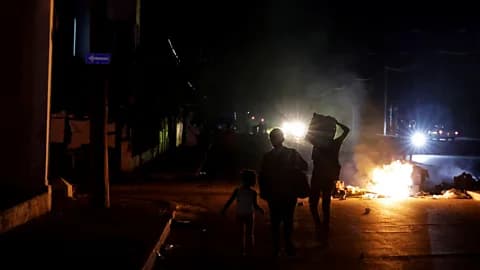
- In response to the prolonged power outages, protests have erupted in various neighborhoods, particularly around Havana, where residents have been seen banging pots and pans, blocking roads, and setting trash cans on fire.
- Cuban President Miguel Diaz-Canel and other officials have consistently blamed the crisis on U.S. sanctions and an 'energy blockade,' which they claim has intensified since January and threatens countries supplying fuel to Cuba.
Why it matters
Competing interpretations
The same facts are interpreted differently: the U.S. sanctions are seen by Cuba as a 'genocidal energy blockade' designed to destabilize the country, while the U.S. frames them as a tool to pressure for democratic and economic reforms. Similarly, the U.S. $100 million aid offer is presented by the U.S. as a benevolent humanitarian gesture, but by Cuba as either a 'fable' or a politically motivated offer lacking transparency and respect for sovereignty.
Where disagreement lives
The primary fault line lives in the causal attribution of the energy crisis and the sincerity and conditions of proposed humanitarian aid. Cuba attributes the crisis solely to external U.S. sanctions, while the U.S. points to the Cuban regime's internal failures and its refusal of aid. This disagreement extends to the interpretation of the sanctions' intent and impact, and whether the U.S. aid offer is a genuine humanitarian gesture or a political maneuver.
What's still uncertain
The precise details and private communications surrounding the U.S. $100 million aid offer remain unclear, making it difficult to ascertain the sincerity of the offer or the Cuban government's actual awareness and specific reasons for rejection. We also lack detailed, independently verified data on the full extent of internal Cuban economic policies or governance issues that may exacerbate the energy crisis, beyond the acknowledged aging infrastructure.
Who Is Affected
Cuban Citizens
Enduring severe daily blackouts, food spoilage, reduced work hours, and limited access to essential services, leading to widespread frustration and protests.
Cuban Government
Facing intense domestic pressure from protests and international pressure from sanctions, while struggling to maintain control and secure vital resources.
U.S. Government
Navigating a complex foreign policy challenge, balancing humanitarian concerns with strategic objectives of promoting regime change and democracy in Cuba.
International Aid Organizations
Potentially caught in the political crossfire, facing challenges in delivering aid effectively and impartially due to geopolitical tensions and lack of trust.
Human stakes
For ordinary Cubans, this crisis means living in near-constant darkness, struggling to preserve food, charge essential devices like phones and electric mopeds, and perform basic daily tasks. It translates into lost work hours, canceled surgeries, and the profound stress of uncertainty, eroding the quality of life and civic trust. The protests reflect a desperate plea for basic services, transcending political rhetoric to demand fundamental human dignity and stability amidst severe material deprivation.
Source spectrum
Issue intelligence
Judgments for navigating this story—not scores. Expand tooltips on each chip for rationale.
Note. Evidence confidence is about factual solidity; uncertainty is about how open-ended outcomes still are. Both can be high at once.
Decision matrix
Compares major options at a glance. Cells are summaries, not forecasts; tradeoffs are simplified for clarity.
| Option | Upside | Risk | Who benefits | Who bears cost |
|---|---|---|---|---|
| U.S. maintains current sanctions and conditional aid offer. | Maintains pressure for political reform in Cuba, aligns with existing U.S. policy objectives. | Exacerbates humanitarian crisis, fuels anti-U.S. sentiment, potentially strengthens Cuban regime's narrative of external blame, risks further instability. | U.S. political factions advocating for regime change, Cuban hardliners who can blame external forces. | Cuban citizens, U.S. reputation as a humanitarian actor, regional stability. |
| U.S. temporarily lifts specific sanctions related to fuel and humanitarian goods, without political preconditions. | Immediate humanitarian relief for Cuban citizens, potential for de-escalation, builds goodwill for future dialogue. | Could be perceived as a concession without achieving political reforms, might be exploited by the Cuban regime, risks domestic political backlash in the U.S. | Cuban citizens, international humanitarian organizations, potentially U.S. long-term diplomatic standing. | U.S. political factions prioritizing immediate regime change, Cuban hardliners who might lose a convenient external enemy. |
| Cuba accepts U.S. aid and engages in dialogue on reforms, while seeking diversified international partnerships. | Alleviates immediate suffering, opens pathways for long-term economic and energy stability, potentially leads to internal improvements. | Risks internal political backlash for perceived compromise, may not fully address systemic issues, could be seen as legitimizing U.S. pressure tactics. | Cuban citizens, potentially the Cuban government through increased stability and resources. | Cuban hardliners, U.S. political factions who prefer a more confrontational approach. |
Plausible paths forward
Our assessment
Structural read
This crisis exemplifies how ideological purity, when pursued through instruments like sanctions without sufficient consideration for implementation realities or humanitarian tradeoffs, can lead to systemic breakdown. The reliance on an aging energy infrastructure, coupled with external pressures, creates a feedback loop of instability. Both the U.S. and Cuban governments appear locked into positions that prioritize strategic advantage over the immediate well-being of the Cuban populace, highlighting a failure of institutions to learn and self-correct. A durable solution requires acknowledging the multi-faceted nature of the problem, moving beyond a heroes-and-villains framework, and seeking hybrid solutions that address both material needs and institutional reforms.
Source reliability
Source reliability (6)
- Al Jazeerastate media · international · primary reporting
Al Jazeera is an international news organization funded by the Qatari government. This article reports on events in Cuba, citing Cuban officials and an international news agency (AFP), as well as unnamed residents. Readers should calibrate for the outlet's editorial perspective, which may align with or diverge from Western narratives, and the reliance on official statements from the Cuban government, which may present a particular framing of the crisis.
- CNBCwire · international · aggregation
CNBC is an international business news outlet. This article aggregates information from state media (Cuban Energy Minister via BBC) and other news agencies (Reuters). Readers should note that CNBC is reporting on statements and other outlets' reporting, not conducting its own on-the-ground investigation for this specific piece.
- WCVBlocal news · international · syndicated
WCVB is a local news outlet reporting on international events. This article appears to be based on syndicated content, likely from the Associated Press, which is a reputable wire service. Readers should understand that WCVB is relaying information from other sources rather than conducting its own on-the-ground reporting in Cuba.
- CNNwire · international · primary reporting
CNN is a major international news organization reporting on global events, directly quoting Cuban officials and citing US State Department releases. Readers should calibrate for the selection of information and framing inherent in international reporting on geopolitical issues.
- BBC Newswire · on the ground · primary reporting
BBC News is a major international news organization that conducts primary reporting from various global locations, including direct interviews with officials and local residents. It demonstrates high transparency in its sourcing, attributing statements to specific individuals and media outlets.
- UPIwire · international · primary reporting
UPI is a wire service known for factual reporting and direct quotes from sources. Readers should note that this article presents claims from both Cuban and U.S. officials, reflecting their respective positions without independent verification of all assertions.
Incentives
Stated goals vs plausible private incentives—evidence strength is an analytic judgment, not proof of bad faith.
| Actor | Stated goal | Likely private incentive | Evidence |
|---|---|---|---|
| Cuban Government | Maintain sovereignty, resist U.S. interference, alleviate energy crisis. | Preserve political power, avoid internal dissent, secure external support from allies. | strong |
| U.S. Government | Promote democracy and human rights in Cuba, compel political and economic reforms. | Demonstrate resolve against communist regimes, satisfy domestic political constituencies, prevent regional instability that could affect U.S. interests. | strong |
| Cuban Citizens | Restore electricity, access basic necessities, improve living conditions. | Survival, stability, ability to work and care for families, potential for migration if conditions do not improve. | strong |
Institutional stress
Second-order effects
Increased migration from Cuba due to deteriorating living conditions and lack of basic services.
Probability: high · Horizon: short · Affected: Cuban citizens, Neighboring countries, U.S. border agencies
Further erosion of trust in international humanitarian efforts if aid offers are perceived as political tools.
Probability: medium · Horizon: medium · Affected: International aid organizations, Recipient nations, Donor nations
Temporal signal
How the signal travels in time: noise versus structure, and how long institutions may remember it.
- Significance
- structural shift
- Durability
- months
- Institutional memory
- high
The crisis is not mere noise; it reflects a structural breakdown in Cuba's energy system and a long-term geopolitical standoff. Its effects will last for months, if not years, and it draws heavily on decades of institutional memory regarding U.S.-Cuba relations.
Civilizational memory
Echoes and precedents across time—interpretive, not a factual source for this event.
Historical rhymes
- Cold War-era proxy conflicts
- humanitarian crises exacerbated by sanctions
- island nations facing resource scarcity
Institutional precedents
- U.S. embargoes against Cuba (since 1960s)
- international aid offers with political conditions
The crisis underscores the enduring challenge of balancing national sovereignty with humanitarian imperatives, particularly when geopolitical rivalries intersect with the basic needs of a population. It tests the capacity of international systems to mediate conflict and deliver aid without exacerbating political tensions.
Counterfactual intelligence
If the U.S. had not tightened restrictions on fuel shipments to Cuba in January, the immediate fuel depletion and subsequent widespread blackouts might have been delayed or less severe, potentially averting the current level of public protests. However, the underlying fragility of Cuba's aging energy grid and its long-term economic challenges would likely still persist, leading to a similar crisis eventually.
Policy levers
- targeted sanctions relief for humanitarian goods
- multilateral aid coordination
- investment in renewable energy infrastructure
Fragile assumptions
- that sanctions alone will lead to desired political reforms
- that the Cuban government can independently resolve the energy crisis without external fuel
- that humanitarian aid can be fully decoupled from political objectives
Epistemic governance
Institutional trust, coordination, values in tension, and testable forecasts—models for reasoning, not verdicts of fact.
Institutional integrity
Epistemic diversity
- geopolitical analysis
- humanitarian assessment
- economic sanctions theory
The reporting clearly presents the divergent claims and interpretations from both the Cuban and U.S. governments, preserving the visibility of disagreement rather than seeking a false consensus.
Reality contact
The analysis consistently highlights the direct and severe impact on ordinary Cuban citizens, including blackouts, food spoilage, and disruptions to daily life, ensuring the human cost is central.
Details like residents banging pots and pans, blocking roads with garbage, and enduring 20-22 hour blackouts in Havana provide concrete texture to the crisis.
Risk signals (relative)
- Prestige biaslow
- Elite consensus lock-inlow
- Engagement optimizationmedium
- Narrative comfortlow
- Institutional avoidancelow
Coherence
The analysis maintains a focus on systemic issues and tradeoffs, aligning with a commitment to understanding complex realities rather than simplifying them into moral binaries.
Civilizational meaning
The crisis serves as a stark reminder of the fragility of modern infrastructure and the profound human cost when geopolitical strategies override basic humanitarian considerations, echoing historical patterns of state power impacting civilian populations.
Institutional legitimacy
- Cuban Government
The widespread protests and inability to provide basic services directly undermine the government's legitimacy and its social contract with its citizens, leading to public discontent.
- U.S. Sanctions Policy
The humanitarian impact of the sanctions, particularly the 'energy blockade' as framed by Cuba, raises questions about the moral and legal legitimacy of such measures, especially when aid offers are entangled with political conditions.
Coordination
Coordination is severely hampered by decades of ideological mistrust and a lack of transparent communication, creating a deadlock where both sides prioritize their strategic narratives over the immediate humanitarian crisis. This makes cross-institutional cooperation, even for aid delivery, extremely difficult.
Cross-institutional feasibility: low
Barriers
- deep-seated ideological mistrust between U.S. and Cuba
- lack of transparency regarding aid offers and conditions
- Cuban government's sovereignty concerns regarding external intervention
Collective action traps
- each side waiting for the other to make the first significant concession
- prioritizing political messaging over practical solutions
Incentive deadlocks
- U.S. incentive to maintain pressure for reform vs. Cuban incentive to resist perceived interference
Moral tradeoff surface
- National Sovereignty ↔ Humanitarian ReliefTension strength: 80%
The Cuban government's assertion of sovereignty and rejection of conditional aid directly conflicts with the immediate need for humanitarian relief for its citizens.
- Strategic Pressure for Reform ↔ Avoidance of Civilian HarmTension strength: 90%
The U.S. policy of sanctions aims to pressure for reform, but this strategy directly contributes to severe civilian harm through fuel shortages and blackouts.
Forecasts and calibration
Resolvable claims recorded at publish time for later outcome tracking.
- Within the next three months, Cuba will secure a significant, sustained alternative source of fuel imports (e.g., from Russia, China, or another non-U.S. allied nation) sufficient to substantially alleviate the current level of blackouts (i.e., reducing daily outages to less than 8 hours in Havana).Domain: geopolitics, energyKind: de escalationTier: mediumResolve by: 2026-08-14
- Over the next six months, the U.S. will either publicly withdraw its $100 million aid offer or significantly alter its conditions to be less politically prescriptive, in response to international pressure or humanitarian concerns.Domain: diplomacy, foreign policyKind: institutional changeTier: lowResolve by: 2026-11-14
Related News


Comments
Revisions(1)
Cuba’s energy crisis to worsen as donated Russian oil runs out, minister warns
CurrentCognition tier backfill (compression + gated deep/civilizational fields)