Kim Jong Un's Daughter's Public Appearances Fuel Debate on North Korea Succession
Disagreement:institutional
Values Alignment:
●●○○○3/10
Entities Mentioned
⚡Key Takeaways
- 1Kim Jong Un's strategic use of his daughter's public appearances signals a calculated effort to solidify dynastic succession and ensure regime stability in North Korea.
- 2The increasing visibility of Kim Ju Ae, particularly at symbolically significant locations like the Kumsusan Palace, reinforces the Kim family's inherited authority and political legitimacy.
- 3While some analysts interpret Kim Ju Ae's prominence as a clear sign of succession, others remain cautious due to her young age and the patriarchal nature of North Korean society.
- 4North Korea's emphasis on its 'Paektu bloodline' and the deification of past leaders highlights the regime's reliance on historical narratives to maintain power and control.
- 5The international community's response to North Korea's dynastic succession plans and its ongoing military developments will significantly shape the future of the region.
What Happened
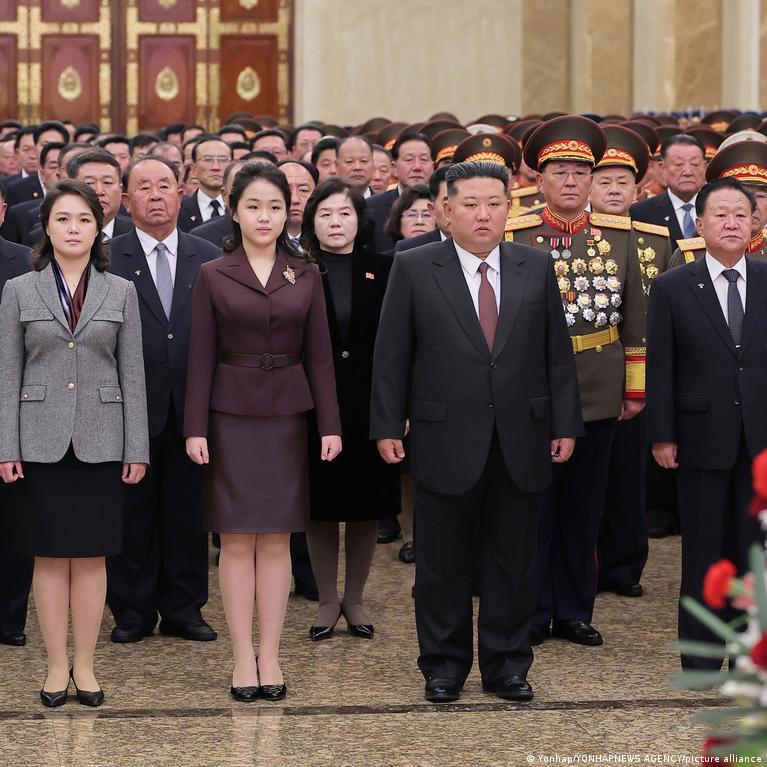
- •Kim Jong Un's daughter, Kim Ju Ae, has made increasingly prominent public appearances, including a visit to the Kumsusan Palace of the Sun, where the bodies of Kim Il Sung and Kim Jong Il are enshrined; this mausoleum visit, which occurred on New Year's Day, is her first known public visit to the site.
- •State media outlets like KCNA have released images of Kim Ju Ae accompanying her parents and high-ranking officials, further fueling speculation about her potential as Kim Jong Un's successor; this contrasts with the secrecy surrounding previous leaders' children before their ascensions.
- •South Korea's intelligence agency (NIS) has suggested that Kim Ju Ae is likely next in line to rule North Korea, based on her high-profile appearances and her father's actions, including a visit to Beijing; however, some experts disagree, citing Kim Jong Un's relative youth and the male-dominated power structure.
- •Kim Ju Ae was first publicly introduced in 2022 at an intercontinental ballistic missile launch and has since been referred to as 'the beloved child' and a 'great person of guidance' by state media, signaling her rising status within the regime.
- •The upcoming Workers' Party congress is expected to address new policy priorities and potentially reshuffle officials, with some analysts suggesting Kim Ju Ae could be given a high-ranking position, further solidifying her role in the country's leadership.
Opposite Sides
←North Korean Government
The Kim dynasty's actions are aimed at ensuring stability and continuity through a clear succession plan, solidifying the regime's legitimacy and reinforcing the 'Paektu bloodline' as the foundation of their rule; Kim Ju Ae's public appearances are carefully orchestrated to prepare the public and elite institutions for an eventual transfer of power.
South Korean Intelligence
Kim Ju Ae's increasing visibility suggests she is being groomed as the next leader, but the situation remains uncertain due to Kim Jong Un's relatively young age and the potential for internal power struggles; monitoring North Korea's internal dynamics and succession planning is crucial for regional security.
International Observers↔
The dynastic succession raises concerns about human rights and the lack of democratic processes in North Korea; the international community should pressure North Korea to improve its human rights record and engage in denuclearization talks, regardless of who leads the country.
The Unspoken Tension
The unspoken tension lies in the inherent instability of a hereditary dictatorship in the 21st century, particularly one with nuclear capabilities; the international community fears that an untested leader could lead to unpredictable and dangerous behavior, while the North Korean regime fears external interference and internal dissent.
⚖️Plausible Solutions (Radical Centrist Approach)
This isn't either/or—it's both/and. To address all perspectives simultaneously:
1. **Conditional Engagement:** Offer phased economic assistance and diplomatic recognition contingent on verifiable steps toward denuclearization and human rights improvements, regardless of the leader.
2. **Multi-lateral Security Guarantees:** Establish a multi-lateral security framework involving regional powers (China, South Korea, Japan, Russia, US) to provide security guarantees to North Korea in exchange for verifiable denuclearization, reducing the regime's perceived need for nuclear weapons.
3. **Track II Diplomacy:** Support unofficial dialogues between North Korean officials, international experts, and civil society representatives to foster understanding and explore potential areas of cooperation.
4. **Transparency and Verification:** Implement robust verification mechanisms, including international inspections, to ensure compliance with denuclearization agreements and human rights standards.
Where the Disagreement Really Lives
Institutional Disagreement
The disagreement is about how systems, institutions, or structures should function—conflicts over governance, processes, or institutional design.
What We Know / What We Don't
✓
What We Know
Kim Jong Un's daughter, Kim Ju Ae, has made several public appearances, including a visit to the Kumsusan Palace of the Sun on January 1, 2026; she was first introduced to the public in 2022 at an intercontinental ballistic missile launch; South Korean intelligence suggests she is being groomed as his successor, though this remains unconfirmed; North Korean state media has referred to her with honorifics typically reserved for top leaders.
?
What We Don't Know
The exact number and gender of Kim Jong Un's other children remain unconfirmed, and the internal dynamics of North Korean leadership succession are opaque; the specific role Kim Ju Ae will play in the upcoming Workers' Party congress is also uncertain; the long-term stability of a hereditary dictatorship in North Korea is questionable, given internal and external pressures.
Plausible Paths Forward
1
If Kim Ju Ae is formally designated as Kim Jong Un's successor at the upcoming Workers' Party Congress.:
This would solidify the Kim dynasty's control and likely lead to increased international scrutiny and sanctions; it could also trigger internal power struggles if other factions within the regime challenge her authority; the international community would likely condemn the move as undemocratic.
2
If Kim Jong Un remains in power for the foreseeable future, and Kim Ju Ae's public profile gradually diminishes.:
This could indicate a shift in succession plans or a desire to maintain the status quo; it might also suggest that Kim Jong Un is grooming another, less visible successor, potentially a son; the regime would continue its focus on military development and internal control.
3
If Internal instability arises due to Kim Jong Un's declining health or other factors, leading to a power struggle among different factions.:
This could result in a period of political turmoil and uncertainty, potentially destabilizing the region; it could also create opportunities for external intervention or a change in the regime's leadership; the outcome would depend on the balance of power among competing factions and the role of external actors.
The Quiet Take
💭
The focus on Kim Ju Ae's succession masks deeper structural problems within North Korea, including a lack of democratic institutions, human rights abuses, and economic stagnation; the international community's fixation on leadership transitions distracts from addressing these underlying issues; a more effective approach would involve promoting gradual reforms, supporting civil society initiatives, and fostering greater transparency and accountability within the regime.
What Would Change Our View
↻
Conditions That Would Shift Our Assessment
Confirmation of Kim Jong Un's health status, the emergence of a credible alternative successor, or a significant shift in North Korea's foreign policy would fundamentally alter this analysis; concrete evidence of internal dissent or a change in the regime's ideology would also necessitate a reevaluation of the situation.
Source Political Spectrum
Loading spectrum data...
Explore coverage from 47 different publications
Comments
Loading comments...